


Car Maintenance at 100000 Miles: Key Checks

One hundred thousand miles is not a finish line for a well-kept vehicle. It is a decision point. Car maintenance at 100000 miles gives you a chance to catch wear before it becomes a roadside problem, an expensive tow, or a repair that sidelines your car for days.
For Portland drivers, that decision often shows up in small ways first: brakes that feel less confident in the rain, a battery that cranks slowly on a cold morning, tires wearing unevenly after months of potholes and stop-and-go traffic. A proper 100,000-mile service is not one universal package. The right work depends on your vehicle's maintenance history, its manufacturer schedule, and what an inspection finds now.
Start With the Manufacturer's 100,000-Mile Schedule
Your owner's manual is the baseline. Some vehicles call for spark plugs at 100,000 miles, while others use plugs rated for 120,000 miles or more. Certain transmissions require regular fluid service; others are marketed with "lifetime" fluid, which still deserves a real conversation when the car has high mileage and sees city driving, heat, hills, or towing.
Bring service records if you have them. They help separate work that is due from work that has already been handled. If you bought the vehicle used and do not know what was done, assume nothing. An inspection and a review of the manufacturer's schedule can establish a practical starting point without replacing parts simply because the odometer reached a round number.
Mileage matters, but time matters too. Brake fluid, coolant, rubber hoses, tires, and batteries age whether a vehicle travels 5,000 or 15,000 miles a year. A low-mileage 10-year-old car may need different attention than a newer commuter car that reaches 100,000 miles in five years.
Car Maintenance at 100,000 Miles: Fluids First
Fluids protect the parts that cost the most to repair. A technician should check their level, condition, possible contamination, and signs of leaks rather than treating every service as an automatic flush.
Engine oil and the oil filter remain the obvious starting point. Continue using the oil grade and change interval specified for your engine. If the vehicle burns oil between changes, has sludge concerns, or shows oil seepage around gaskets, address the cause instead of just topping it off indefinitely.
Coolant deserves close attention at this mileage. Old or incorrect coolant can contribute to corrosion, overheating, heater problems, and damage to components such as the radiator, water pump, and heater core. The correct coolant type matters. Mixing formulas because they are all colorful liquids is an easy way to create trouble.
Brake fluid absorbs moisture over time. That moisture can reduce braking performance under hard use and contribute to corrosion in brake components. If the fluid tests poorly or the maintenance schedule calls for replacement, a brake fluid exchange is sensible preventive work.
Transmission fluid, differential fluid, transfer case fluid, and power steering fluid vary widely by vehicle. This is where a one-size-fits-all recommendation can do more harm than good. A qualified shop should identify the system, inspect fluid condition, account for service history, and recommend the proper service method. A transmission that is already slipping or shifting harshly needs diagnosis before anyone promises that a fluid service will solve it.
Inspect Belts, Hoses, and the Cooling System
Rubber parts rarely fail on a convenient schedule. At 100,000 miles, inspect the serpentine belt for cracks, fraying, glazing, or contamination from an oil leak. A worn belt can leave you without charging, power steering assistance on applicable vehicles, or proper coolant circulation depending on the engine design.
Hoses, clamps, the radiator, and the water pump also deserve attention. Look for dried coolant residue, swelling hoses, loose clamps, and damp spots around the water pump or radiator. A small leak may not create an immediate temperature warning, but it can turn into an overheating event quickly.
Do not confuse the serpentine belt with a timing belt. If your engine uses a timing belt, its replacement interval is critical. Many timing belts are due somewhere around this mileage range, but the exact schedule is make- and model-specific. A failed timing belt can cause major engine damage on interference engines. If your vehicle has a timing chain, it generally does not have a routine replacement interval, but rattling at startup, timing-related codes, or poor running should be checked promptly.
Address Spark Plugs and Engine Performance
Many modern vehicles use long-life iridium or platinum spark plugs that are due near 100,000 miles. As plugs wear, the engine may misfire under load, idle roughly, lose fuel economy, or trigger a check engine light. On some engines, spark plug access is straightforward. On others, replacing plugs involves significant disassembly, which makes it especially worthwhile to use the correct parts and inspect related components during the job.
Ignition coils are not always maintenance items, so replacing every coil preemptively is not necessary on most vehicles. However, a technician should inspect for oil in spark plug wells, damaged wiring, and stored misfire codes. These clues can point to a valve cover gasket issue, a failing coil, or a fuel delivery problem instead of worn plugs alone.
If the check engine light is on, diagnosis comes before parts replacement. Modern vehicles can set similar codes for very different reasons. A scan tool is a starting point, not a final answer.
Do Not Put Off Brakes, Tires, and Suspension
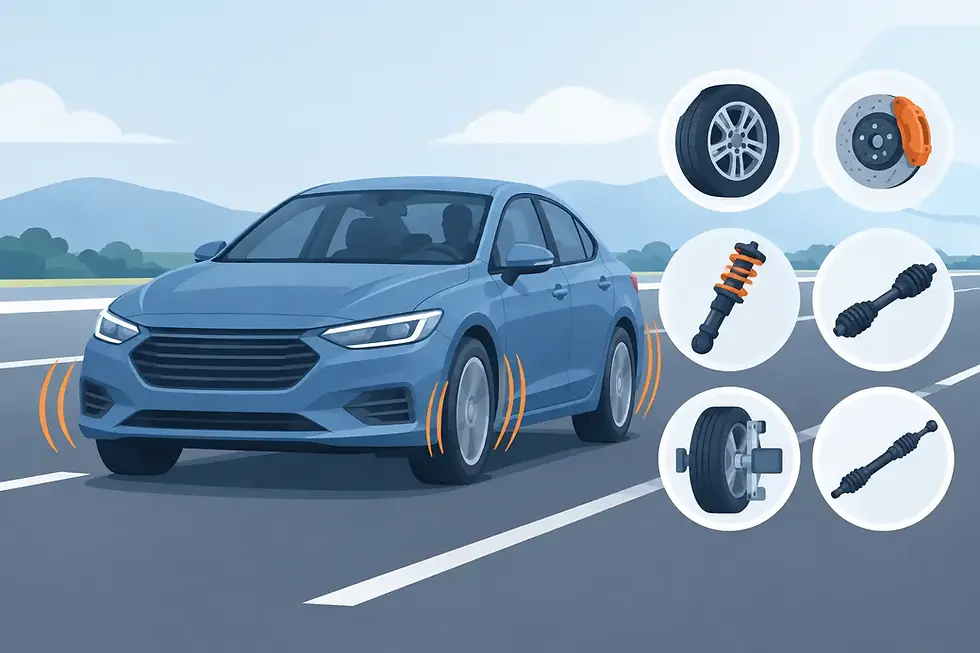
Portland rain makes tire tread and brake condition more than routine maintenance. They are daily safety items. Brake pads, rotors, calipers, brake hoses, and parking brake operation should be inspected for wear, corrosion, leaks, and uneven operation. Squealing, grinding, a soft pedal, pulling during braking, or steering-wheel vibration when stopping all warrant an appointment sooner rather than later.
Tires should be checked for remaining tread depth, sidewall cracking, puncture damage, and irregular wear. Uneven wear can indicate an alignment issue, weak struts, worn ball joints, loose tie rods, or a tire balance problem. Replacing tires without finding the cause of abnormal wear can shorten the life of the new set.
Suspension and steering wear tends to creep up gradually. You may get used to a vehicle that bounces excessively, clunks over bumps, wanders on the freeway, or needs constant steering correction. At 100,000 miles, inspect shocks or struts, control arm bushings, ball joints, tie rods, wheel bearings, CV axles, and engine mounts where applicable. Not every worn bushing requires immediate replacement, but looseness that affects handling, tire wear, or safety should not wait.
Test the Battery and Charging System
A battery can test fine one week and fail during the next cold snap. Battery age, terminal condition, charging voltage, and starting performance all matter. Corroded terminals and weak connections can mimic a bad battery, while a failing alternator can leave a good battery undercharged.
Electrical diagnosis is especially valuable when warning lights appear intermittently, accessories act strangely, or the vehicle has a no-start condition that does not happen every time. Guessing at batteries, starters, alternators, or modules gets expensive fast. Testing the system identifies where the problem actually is.
Prioritize the Work Without Ignoring the Big Picture
A 100,000-mile inspection can produce a long list, especially if earlier maintenance was missed. That does not mean every item has the same urgency. Start with safety concerns such as brakes, tires, steering, suspension looseness, fuel leaks, overheating risks, and warning lights. Next, handle manufacturer-required maintenance that protects major components, including timing belt service and specified fluid changes.
Then plan for developing repairs, such as a minor oil seep, aging battery, or struts beginning to weaken. A clear estimate should explain what is needed now, what can be monitored, and what may be worth budgeting for over the next several months. At Dane Motors, that practical approach starts with inspection and diagnosis, not a blanket list of parts.
If your vehicle is approaching 100,000 miles, schedule the inspection before a warning light, hot day, or rainy commute makes the decision for you. A little planning at this point can keep a familiar, dependable car doing exactly what you need it to do: get you where you are going.


Comments