

Why Car Battery Dies Overnight and What to Check

A car that started normally yesterday but only clicks this morning is more than an inconvenience, especially when you have a commute, school drop-off, or appointment across Portland. If you are asking why car battery dies overnight, the answer is usually not simply that the battery needs a jump. Something may be draining power while the vehicle is parked, the battery may no longer hold a charge, or the charging system may not be replenishing it while you drive.
A jump-start can get you moving once. It does not identify the reason the battery went flat. The fastest way to avoid a repeat is to pay attention to the symptoms and have the charging and electrical systems tested before the next no-start leaves you stranded.
Why a Car Battery Dies Overnight
A healthy, fully charged battery should generally have enough reserve to start your vehicle after sitting overnight. Cold weather can reduce available battery power, and Portland winter mornings can expose a battery that was already weak. Still, a battery that repeatedly dies after a normal evening of driving needs attention.
The most common causes fall into three categories: the battery cannot store enough power, the alternator is not restoring power while the engine runs, or an electrical component is using power after the vehicle is shut off. More than one problem can be present at the same time. For example, an older battery may tolerate a small electrical drain for months, then suddenly stop starting the car when temperatures drop.
An Aging or Damaged Battery
Car batteries do not last forever. Many last roughly three to five years, but heat, short trips, vibration, corrosion, and repeated deep discharges can shorten that range. A battery can show enough voltage to turn on interior lights while still lacking the cranking power needed to start the engine.
Swollen battery cases, leaking fluid, cracked terminals, or heavy corrosion are clear warning signs. So is a battery that needs repeated jumps despite no obvious lights being left on. Battery age matters, but it is not the only test. Replacing a battery without checking the charging system or drain can mean the new battery is dead a few days later for the same underlying reason.
A Parasitic Draw While the Car Is Parked
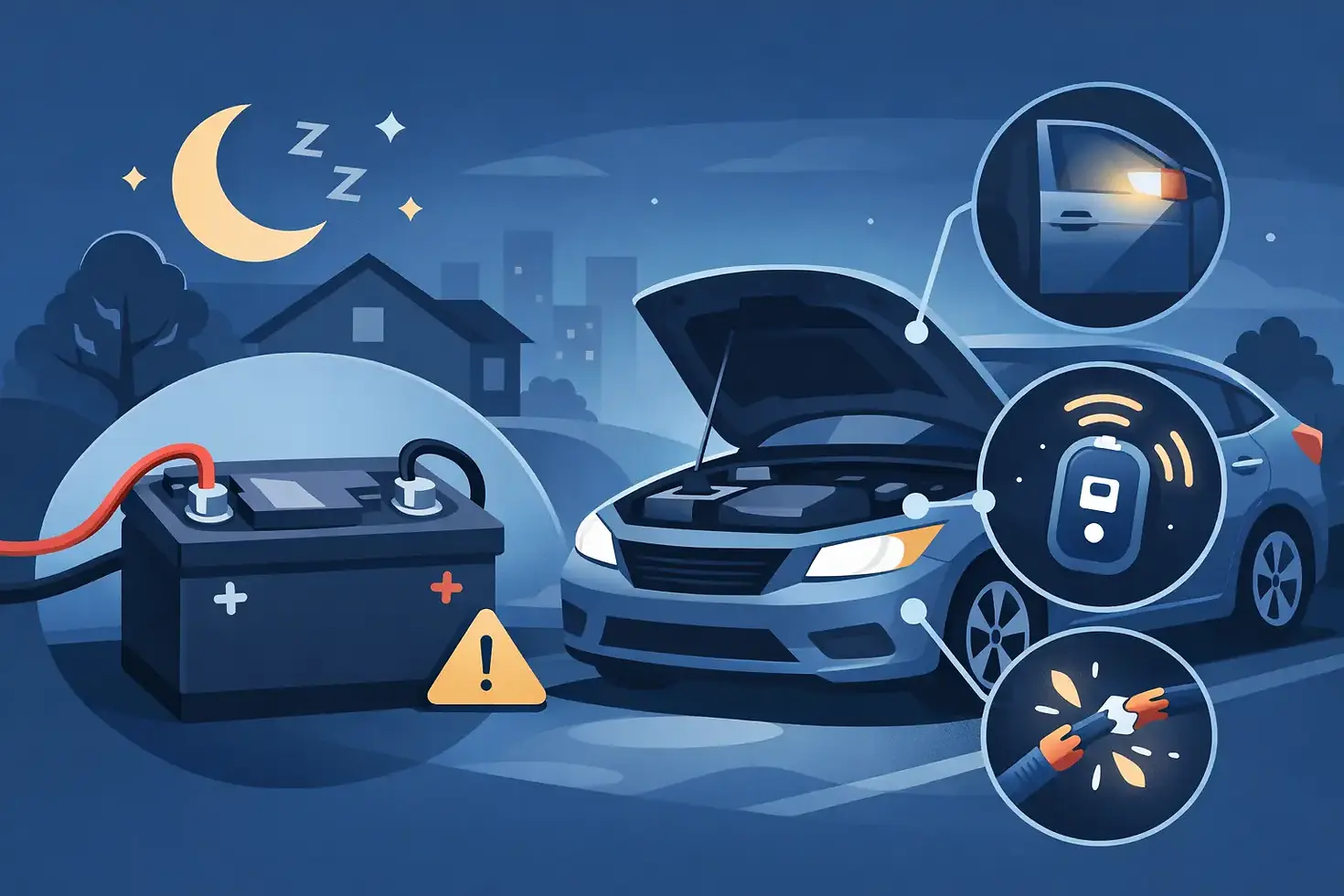
A parasitic draw is power used after the ignition is off. Some draw is normal. The clock, security system, computer memory, and keyless-entry receiver all need a small amount of electricity. The issue begins when a module does not go to sleep, a relay sticks, a light remains on, or an added accessory keeps pulling too much current.
A glove box, trunk, cargo-area, visor-mirror, or under-hood light can be easy to miss. So can an aftermarket dash camera, stereo amplifier, remote starter, alarm, GPS tracker, phone charger, or trailer-brake accessory. These items are not automatically the problem, but they add possible circuits to inspect.
Modern vehicles can also develop drains from door-latch switches, body-control modules, infotainment systems, and other electronic components. Finding that fault takes more than looking under the hood. A technician may need to test current draw after the vehicle has had time to power down, then isolate circuits methodically. Pulling fuses at random can create more questions than answers.
An Alternator or Charging-System Problem
The alternator recharges the battery while the engine is running and supplies power to electrical systems. If it is undercharging, a normal drive may not replace the energy used during starting. Eventually, the battery becomes too depleted to crank the engine, often after sitting overnight.
A battery warning light, headlights that dim at idle, flickering interior lights, a burning smell, or unusual whining can point toward a charging-system concern. But these symptoms vary by vehicle. Some alternator problems are intermittent, and some batteries fail without turning on any warning light at all.
Loose or corroded battery terminals, damaged wiring, a worn drive belt, or poor engine and body grounds can also interfere with charging. That is why a complete test should look beyond the battery itself.
Short Drives and Cold Weather
Starting an engine takes a substantial burst of power. If most of your driving consists of a few minutes to the store, school, or work, the alternator may not have enough time to fully recharge the battery, particularly if you use headlights, defrosters, heated seats, or a blower fan.
This does not mean every short-trip driver needs a new battery. It does mean that a marginal battery can become a problem sooner. Cold temperatures slow the chemical reaction inside a battery, while thicker engine oil makes the starter work harder. A battery that seems acceptable in mild weather may fail on a cold morning.
A Starter Problem That Looks Like a Dead Battery
A slow or no-crank condition is not always caused by the battery. A failing starter, poor connection at the starter, or high resistance in a cable can produce clicking or sluggish cranking. Repeated jump-starts may seem to help because the added voltage masks the issue temporarily.
If the battery tests well and the vehicle still struggles to crank, the starting circuit needs diagnosis. This is especially true when you hear one solid click, the lights stay bright, or the problem occurs inconsistently.
Safe Checks Before Scheduling Service
There are a few useful observations you can make without disassembling anything or risking damage to sensitive electrical systems. First, check whether headlights, interior lights, the radio, and dash lights were left on. Look in the glove box and cargo area to make sure lights turn off when the lids are closed.
Next, inspect the battery terminals with the engine off. They should be secure and free from excessive white, blue, or green corrosion. Do not touch both battery terminals with a tool or attempt to jump the car if the battery case is swollen, cracked, leaking, or frozen.
If you have a multimeter and know how to use one safely, a battery that has rested for several hours should usually measure around 12.6 volts when fully charged. A reading near 12.2 volts indicates a low state of charge, but voltage alone does not prove why the battery is low or whether it can pass a load test. Running voltage can offer clues about alternator output, yet modern charging systems may vary output by design. A professional test remains the better answer when the failure repeats.
Before your appointment, make note of four details:
How long the vehicle sat before it would not start.
Whether it started after a jump and then died again later.
Any warning lights, dim lights, clicking, or unusual electrical behavior.
Recent battery replacement, accessory installation, collision repair, or rodent damage.
Those details help narrow the diagnostic path and can save time.
When an Overnight Battery Drain Needs Electrical Diagnosis
Schedule a diagnostic inspection if the battery has died more than once, the battery light is on, or you have already replaced the battery and the problem returned. A proper evaluation may include battery load testing, alternator-output testing, voltage-drop testing at cables and grounds, and a parasitic-draw test. The exact test sequence depends on what the vehicle is doing.
For a suspected drain, the vehicle may need to sit long enough for computers and modules to enter sleep mode. That is one reason an overnight battery issue is not always solved during a quick walk-in check. Electrical diagnosis is a process of testing evidence, not guessing which expensive part to replace.
At Dane Motors, we work on all makes and models and can diagnose battery, charging, starting, and electrical concerns. If the vehicle cannot reliably start, ask about arranging service before it turns into a missed workday. Overnight drop-off can also make it easier to get the car checked without rearranging your entire schedule.
A battery charger can be useful for restoring a discharged battery, but treat it as a way to recover enough charge for testing, not proof that the problem is fixed. Once the battery is charged, the next start and the next overnight park are what tell the real story. Getting the system tested now is usually simpler than waiting for the next cold morning and another set of jumper cables.


Comments